Facade of the Second Branch Bank of the United States
Artwork Details
- Title: Facade of the Second Branch Bank of the United States
- Architect: Martin Euclid Thompson (American, 1786–1877 Glen Cove, New York)
- Date: 1822–24
- Geography: Made in New York, New York, United States
- Culture: American
- Medium: Marble
- Credit Line: Gift of Robert W. de Forest, 1924
- Object Number: AW.BankFacade
- Curatorial Department: The American Wing
Audio
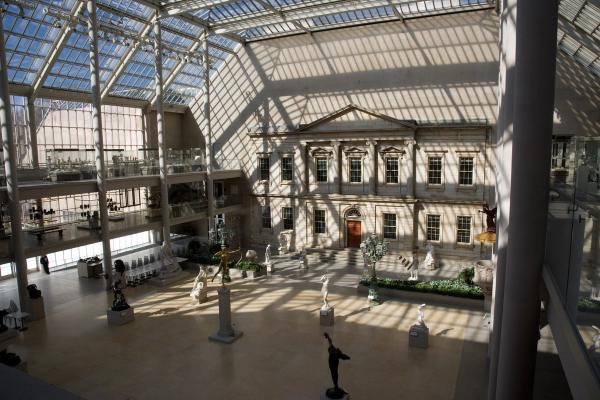
5862. Charles Engelhard Court, Part 2
Highlights Tour
Early on most of the Met’s founders felt that they should focus on acquiring European works. But in 1909, New York celebrated the three-hundredth anniversary of Henry Hudson’s voyage along the river that marks his name – and the Met mounted a watershed exhibition including early American decorative arts. In the words of Museum trustee Robert de Forest, the exhibition was a way “to test out the question [of] whether American domestic art was worthy of a place in an art museum.” The public embraced it, and American art became popular. De Forest himself was very enthusiastic. He later became president of the Met, and in 1922 he announced a plan to build a wing devoted to American art—this section of the Museum, recently renovated, is the result. On several floors of galleries you’ll find superb examples of furniture, silver, glass, and ceramics. Beyond the bank façade there are historic interiors and renowned works of painting and sculpture.
Listen to more about this artwork
More Artwork
Press the down key to skip to the last item.
Research Resources
The Met provides unparalleled resources for research and welcomes an international community of students and scholars. The Met's Open Access API is where creators and researchers can connect to the The Met collection. Open Access data and public domain images are available for unrestricted commercial and noncommercial use without permission or fee.
To request images under copyright and other restrictions, please use this Image Request form.
Feedback
We continue to research and examine historical and cultural context for objects in The Met collection. If you have comments or questions about this object record, please contact us using the form below. The Museum looks forward to receiving your comments.